Showing posts with label math. Show all posts

Sunday, October 25, 2015

Math Center Ideas - Compare and Sort Shapes

Hello everyone!  It's Greg Coleman from Mr Elementary Math and I wanted to share a fun math center Kindergarten.  This focus of this center is comparing and sorting shapes.


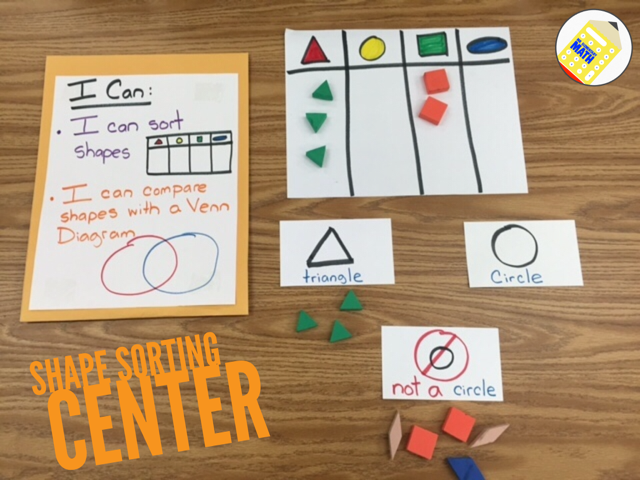
Center Name:  Shape Sorting

Purpose: Students will sort shapes into different categories based on their attributes.

Materials Needed:
- Shapes (Ex. circles, squares, triangles, etc.)
- Index Cards with Attributes Labels (Ex. 3 sides, straight sides, more than 3 sides, etc)
- Recording Sheet

What Do Students Do?
Students sort shapes under the correct index cards.  Students explain to each other how they sorted their shapes.  Students write/draw their findings on a recording sheet.


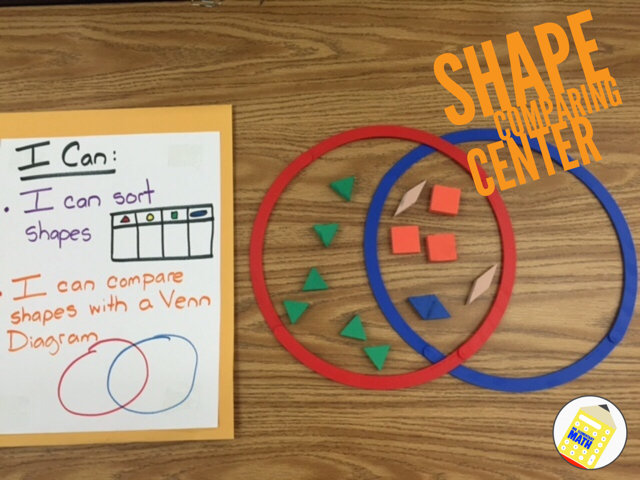
Center Name:  Shape Comparing

Purpose: Students will compare shapes using a Venn diagram.

Materials Needed:
- Shapes (Ex. circles, squares, triangles, etc.)
- Venn diagram
- Recording Sheet

What Do Students Do?
Students compare and contrast different shapes and then place the shapes in the appropriate area of a Venn diagram .  Students explain why they placed certain shapes into the different sections (different, the same) of the Venn diagram.  Students write/draw their findings on a recording sheet.


I hope you enjoyed these ideas.  Happy sorting!!!


Wednesday, October 14, 2015

Free Halloween Activity: Fruit Snack Mini-Book

Hello there!  It's Katie from Resources by Mrs. Roltgen, and I've got a fun, quick little freebie for all of you!

I found these fun Halloween fruit snacks at the grocery store and I knew they would make a fun Halloween activity.  I've done fruit snack sorting with kids before, but I wanted to go beyond basic sorting and incorporate more math skills.  Therefore, I made a mini-book that has students practice a variety of math skills using these Halloween fruit snacks.


Tip:  Plan to give each student two bags of fruit snacks in order to make the activity a little easier.  Some of the packs I opened only have five, some had eight.  Each student needs at least 10 to do the activities.


Here are a few of the pages:

Counting and writing "how many"


A sorting page


Non-standard measurement


Ten frames


...and MORE!  There are also pages for estimation, comparing sets (greater/less than/equal to), and adding more to make five.

I didn't put numbers on the pages, so you can feel free to omit or rearrange the pages as you wish.

To download this FREEBIE, click on the picture below.


Enjoy, and Happy Fall!


Tuesday, September 22, 2015

Ultimate Guide to Graphing in Primary Grades

Do you make graphs with your students? Of course you do, who doesn't? But do you know why it is important and what experiences your students should have to get the most out of graphing activities?

Why is graphing so important?

1. Graphs can engage students and create enthusiasm for math.
2. Graphs can be integrated into any subject, showing students the real world application and purpose for learning math concepts.
3. Graphs give students the opportunity to represent, compare and discuss mathematical relationships and concepts in new ways.
  • Collecting information
  • Tallying information
  • Counting data points
  • Surveying peers or others
  • Sorting objects
  • Making graphs with real objects
  • Making picture graphs
  • Reading graphs
  • Making observations from a graph
  • Comparing results with a friend
  • Asking questions about a graph

Using real objects is a great way to get started on graphing with young students.  Gather any of those awesome math manipulatives or art supplies you have hanging around your classroom. They are great for graphing, by size, color, or type.  Students can sort them and line them up on your table.  You can then have students translate this information into a bar or picture graph. Learning to represent data in different ways is a key understanding for mathematical success.

Snacks are another one of my favorite items to graph with students. I used to love sorting my snacks into groups as a child and kindergarteners seem to do this naturally during snack time in my class anyways. So why not take advantage of this opportunity and have students create a graph and make observations about their data.


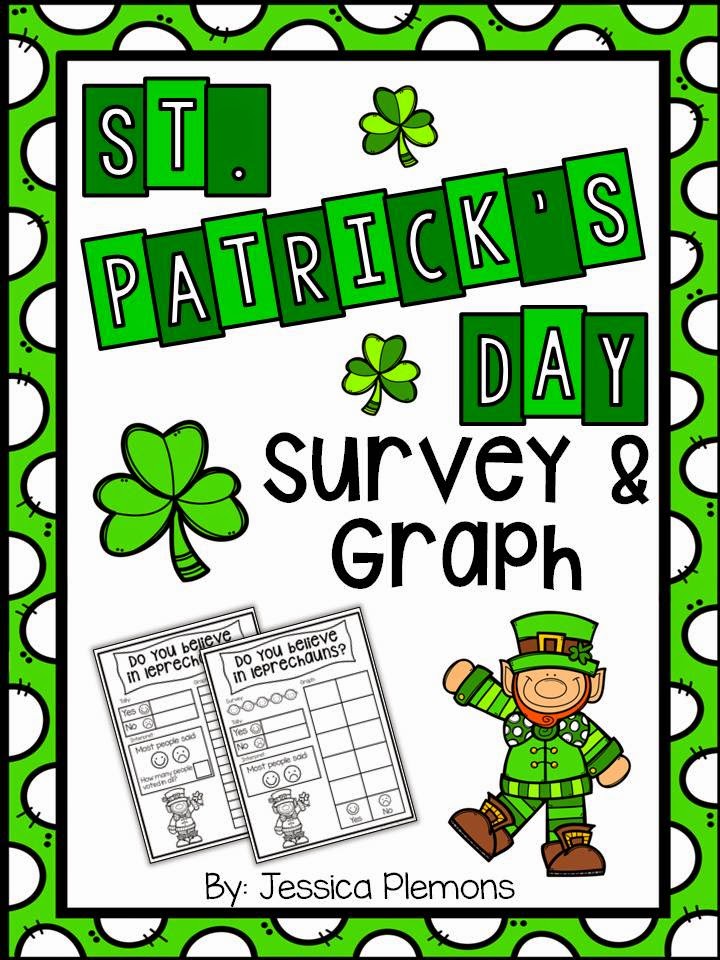
Teaching students to take surveys to collect data is another way to introduce a real world application of graphing.  Maybe you are having a class ice cream party and need to know what flavor everyone would like.  Or maybe a child wants to plan their birthday party at the local pool and wants to know if their friends can swim.  Surveys are a quick efficient way to collect and organize the information you need.
              

So you've created a gorgeous graph, now what? Teaching students to analyze and interpret information from a graph is the ultimate goal. When we encounter graphs in real life we need to be able to gather information and understand what the graph is showing us.  Using open ended questions are a great way to start to get students talking about a graph.  I often ask my students to write what they notice about their graph. I tend to ask what has most and least first to get that out of the way, otherwise this can easily become the only information students feel is important to write about.
After students have the opportunity to tell what they notice you can ask follow up questions about things students may not have noticed.
  • Which item has most/least?
  • Which item has more/less than ___?
  • Which items have the same?
  • How many items were there in all?
  • How many more ___ than ___?
When students create their own graphs based on different sets of data I also like to have them compare their graphs.  For example when students graph a snack, they will likely end up with very different results, leading them to ask different types of questions.
  • What did you have the most of? How is that different from your friend?
  • Why do we have different data? 
  • Are there any patterns we see across multiple graphs?
Looking for some resources to help you get started on graphing in your classroom? Here are 3 FREEBIES for surveying, sorting and graphing.
 

And here are the links to my favorite graphing resources:


Sunday, August 16, 2015

Roll and Cover Math Games

Hi there! It's Alex from The Kindergarten Connection with a fun Sunday Surprise!

I love it when my students get excited about math and enjoy it - I think all teachers can agree that it is important to try to make learning as fun as possible! 

Last year, my students had a very strong interest in dice games - they loved them! They especially loved roll and cover games. 

I loved that they were having fun and learning at the same time!

This year we are going to have tons of roll and cover games to play - and today I am sharing a few of them for FREE with you! 


First is the basic roll and color. This is excellent for students who are learning number recognition. 

You can choose to use traditional dotted dice and have your students count the dots, or you can use numbered dice and have them match numbers. I used the jumbo dice from Target and The Dollar Store because those are always a hit! 

Students roll the dice and color the number that matches. 

You could also provide cubes or manipulatives for students to cover the numbers if you want to reuse the pages. I often do this and put the pages in sheet protectors for extended use.


Next is the addition version of roll and color. You can use two dotted dice and have students count the totals, or use numbered dice and have them add using the number line for help if needed (sums to 12). They find the sum and color the total (or cover if you are choosing that option).


Last is the subtraction version of roll and color. Students roll two dice, subtract the smaller number from the larger, and color the answer. There is a number line included for help. I chose to use numbered dice (each numbered 1-6) for this version, but dotted would work as well. 


Do your kids love roll and color games too? You can grab all 3 of these games for FREE!

Click HERE to download your freebies! 

Want more roll and cover? You may want to check out Roll and Cover Math Games for the Year. That's right - the YEAR!! With 22 different designs and 3 levels of play for each - you have 66 roll and cover games for seasons and holidays throughout the school year!

You can view the complete set HERE.

Don't forget your freebies!! If you haven't already, download them HERE. 

I hope your students enjoy playing these games as much as mine do!

Sunday, August 9, 2015

All About Me Back to School Math Activity

Hello.  This is Greg from Mr. Elementary Math. It is hard to believe that we are back to school or preparing to go back within the next couple of weeks.  For those of you that are beginning to think about back to school activities, hopefully I have a resource that could be added to your collection.  

This activity is great to use during the first days of school. I've used it with upper grade students and recently modified the activity to meet the needs of kindergarten students.  

How does it work?
I introduce myself to the students by sharing 4 "number based" facts about myself. Examples of   "number based" facts can include:
  1. I have been a teacher for _____ years.
  2. I have _____ children or I have ____ child.
  3. I have _____ people in my family.
  4. I have _____ sister(s) and _____  brother(s).
  5. I traveled to _____ places this summer.
  6. I have _____ letters in my name.
Check out my completed example below. 
Math Activity
After sharing my completed version using the template, I ask the students to complete their own All About Me sheets. Check out a completed student sample below.

kindergarten math activity

Lastly, I call students up one by one to present their completed work to the class.  Students love doing this activity because they share information about themselves, see the connection that numbers have in their everyday lives and learn about their classmates. 

For a free version of the template, click here.  If you choose to do this activity, I would love to hear how it went in your classroom in the comments section.

Friday, June 19, 2015

Shape Riddles

Hey there!  It's Andrea from I Heart Kindergarten.  I have been on summer break for 2 weeks already and I'm loving it!  It's so nice to relax, spend time with my little girl, and not have to set my alarm clock!

It's Freebie Friday!  For those of you who are still in school, here's a cute little math activity that my kiddos loved.  And, if you're already out for summer, be sure to tuck this one away for next year!

My students had so much fun learning about shapes this year!  I planned a lot of interactive, hands-on activities, and this was one of their favorites!  Shape Riddles Matching Activity!  Click on the picture below to download the activity to use in your classroom.


The prep is simple.  Just copy the riddle cards, shape name labels, and shapes onto cardstock and laminate for durability.  I decided to use several different colors of cardstock to make a few sets.  


I had my students work in pairs on this activity, but you could also put students in small groups or use this as an independent math center activity.   Students worked together to read the riddles and match each one to the correct shape, then label the shapes with the correct name.  


Students finished up the activity by working on a follow-up cut-and-paste sheet for extra practice.  This sheet could also be used as homework.


Enjoy!
Andrea

Saturday, June 6, 2015

Pete the Cat + a Subtraction FREEBIE


Hi, friends!  Ashley here from One Sharp Bunch!

http://onesharpbunch.blogspot.com/

 I know some of you are already finished with school and most of you are winding down... but this week, I am going to talk about the book Pete the Cat and His Four Groovy Buttons by Eric Litwin.  My kiddos L-O-V-E this book!  The ending is a hoot!  I won't give it away here, but I know your students will enjoy it!


I absolutely love the brightly colored illustrations in this book!  Plus, it is perfect for teaching the concept of subtraction.  First, I read the story, and my kiddos all giggled when we got to the ending.  Then, I pulled out the CD and we listened to the story again.  The CD is a must!  I ordered mine from Scholastic.  The kiddos absolutely loved dancing to the "my buttons" part!  It was PRECIOUS!  After getting all of our wiggles out, we began modeling the problems as we listened to the story for a third time.


I just happened to have some yellow work-mats from our math kit, which worked out perfectly since Pete was wearing a yellow jacket.  Plus, I have a GIANT bag of assorted buttons.  Can you say ZERO PREP?!?! I had planned to save the next part of this lesson for the next day, but my kiddos just couldn't get enough of Pete's groovy buttons!  This time, we used our dry erase boards to model the problems with a picture and a number sentence.  Of course, we listened to the CD just one more time!


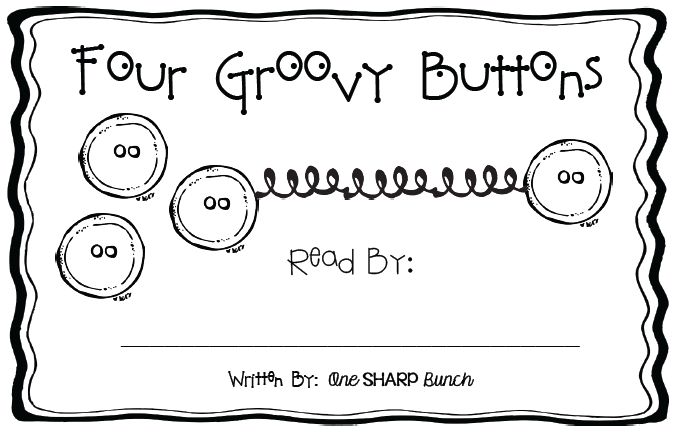
On the next day, we completed the "Four Groovy Buttons" emergent reader.  We practiced modeling the problem with a picture and number sentence.  Then, we read the story with a partner.  I like to call this double-dipping (math and ELA integration). 


If you'd like a copy of this groovy emergent reader, click the link below!


http://www.teacherspayteachers.com/Product/Four-Groovy-Buttons-FREEBIE-1269928
Click here to download the "Four Groovy Buttons" emergent reader!
I hope your kiddos love the story just as much as mine did!  Happy end of the year!